ProPollSoil celebrates World Bee Day 2026 with three events
Every year on May 20th the FAO observes World Bee Day to raise awareness on the essential role bees and other pollinators play in keeping people and the planet healthy. And while Honeybees are without doubt the best-known bee species, this day is traditionally used to highlight the importance of other bees, such as wild bees, solitary bees and ground nesting bees.
This year, ProPollSoil celebrated this important date with multiple events.
Campus bees at the University of Murcia
At the University of Murcia, the lead of our Spanish Case Study Area, the ProPollSoil team celebrated World Bee Day early in the lobby of the Faculty of Biology with the event “Do you know the bees on campus?”. During the event, Pilar de la Rúa Tarin and her colleagues displayed the collection of campus bees from the Animal Phylogeny and Evolution research group, and shared interesting facts about the bee’s life cycles, where they live and how we can help protecting them. The team also presented some of the pollinator conservation initiatives being carried out as part of the ProPollSoil project, as well as our sister projects WildPosh, and Butterfly, and the BioRespond project of excellence funded by the Seneca Foundation.
Art and nature meet in Oslo
Our Norwegian Partner NINA collaborated with Oslo Municipality’s Art Collection and the Agency for Urban Environment on a public event exploring the relationship between wild bees, biodiversity, art, and urban nature in Oslo. The event took place at The Mother by Tracey Emin in Bjørvika, where participants gathered around the flower meadow surrounding the sculpture — an urban habitat designed to support pollinators and other wildlife. The program highlighted how artists are increasingly engaging with ecological questions and requesting that nature becomes an integrated part of public artworks and urban spaces. Through a series of short talks and a guided wild bee safari, visitors learned about the hidden lives of wild bees, the importance of pollinator-friendly habitats, and how cities can be designed to better support biodiversity.
NINA researcher Markus Sydenham introduced audiences to the remarkable diversity of wild bees in Norway, explaining how different bee species depend on specific nesting habitats and flowering plants. The program also highlighted how art and landscape projects can contribute to ecological restoration in cities, showcasing the transformation of the Bjørvika site from an “ecological desert” into a flowering meadow with native plant species and nesting opportunities for pollinators. Representatives from Oslo Municipality shared how urban management practices — including the creation of habitat corridors, reduced mowing, native vegetation planting, and pollinator-friendly maintenance — can help strengthen urban ecosystems for bees and other insects. The event concluded with a guided wild bee safari, where participants explored the meadow and discovered the pollinators already establishing themselves in the area. The day demonstrated how research, public engagement, urban planning, and art can come together to create more biodiverse and resilient cities.
Showcasing pollinators to young and old
At our coordinating institution, Technical University Munich, the team of the Plant Insect Interactions group led by Astrid Neumann shared a stand with our sister project RestPoll to talk all things wild bees. The team showed visitors how to safely catch and identify bees and other pollinators, showed a variety of native and exotic bees and invited visitors to deepen their knowledge about the role of pollinators in their lives. They also invited young and old to solve a jigsaw showing three iconic native pollinators (pantaloon bee, green rose chafer and common drone fly) to win a sticker!
Finally, our coordinator Sara Diana Leonhardt from TUM and pollinator expert Jeff Ollerton participated in an online webinar, run by the Biological Society of Soil Sciences. Together with other guests they discussed the complex dependency of soils and pollinators in front of 107 attendees. A recording of the webinar is available on Youtube.
 World Bee Day stand at the University of Murcia
  Collection of campus bees at the University of Murcia
  Students visiting the ProPollSoil stand at the University of Murcia
 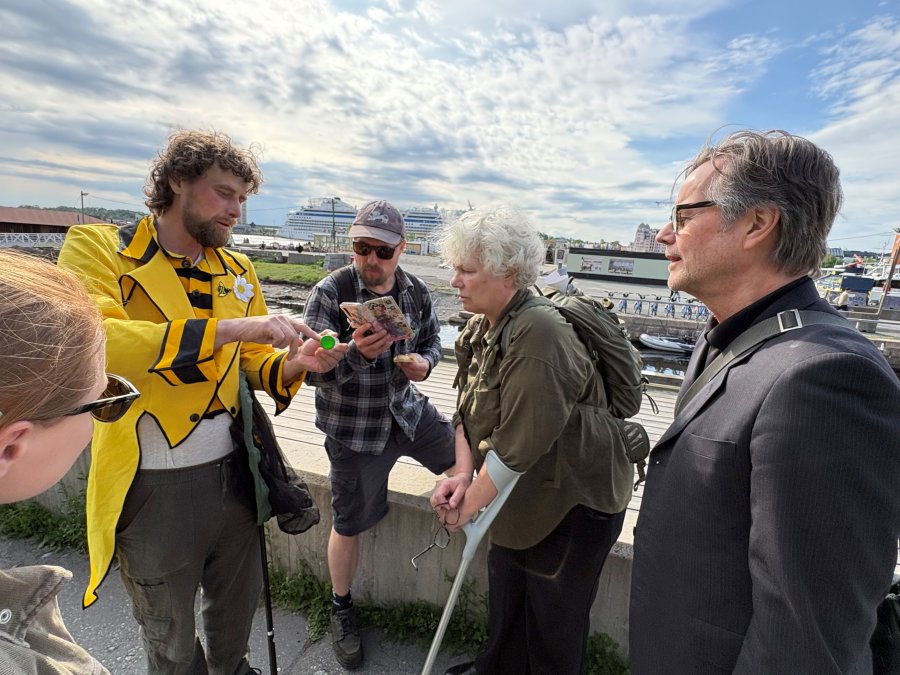 Markus Sydenham from NINA conducts a bee safari in Oslo